Inspection Type
Automated Defect Detection for Automotive Parts
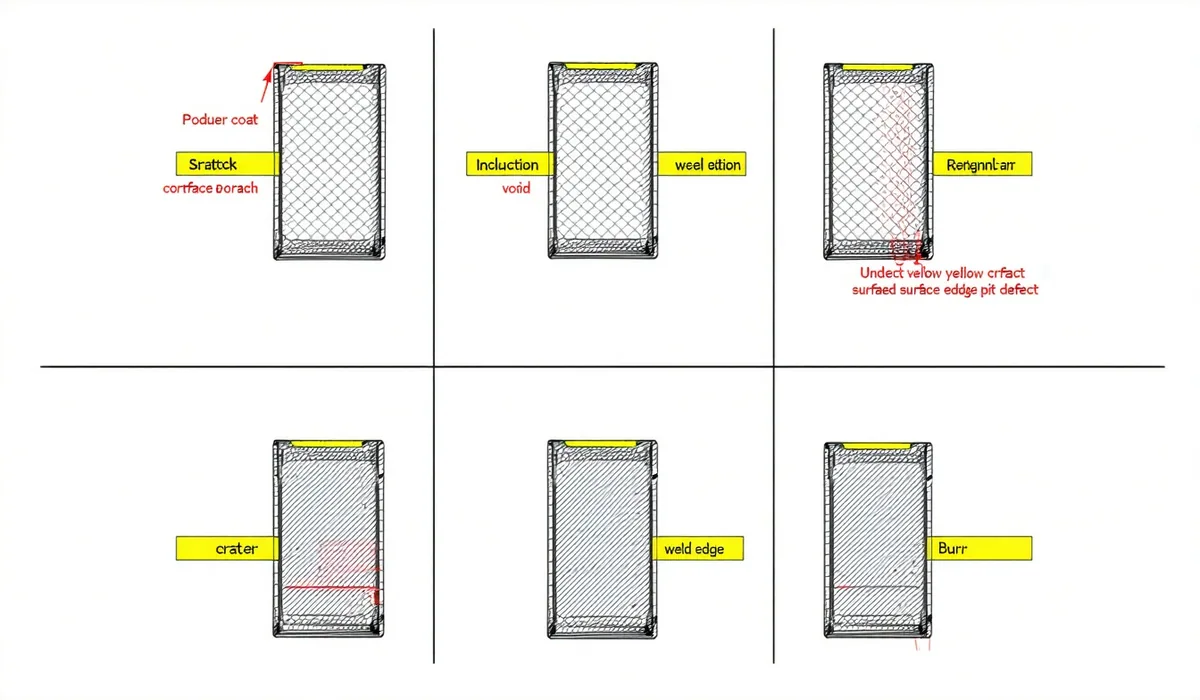
Pixel-level classification of surface anomalies — voids, craters, inclusions, contamination, scratches, and edge burrs — matched against your APQP control plan defect library at line speed.
Standard Coverage
Standard defect classes supported.
Qcvisionly ships with a pre-trained defect taxonomy aligned with AIAG APQP control plan vocabulary. Each class is assigned a unique defect ID in JetBrains Mono format for IATF traceability logging.
Workflow
How AOI works in your production cell.
Part arrives at inspection station
A photoelectric trigger or press cycle output signals the inspection cell. Camera captures a calibrated image within the part fixture window. Cycle time target: under 2 seconds from trigger to classification result.
Edge AI classifies against control plan library
The edge node runs inference against your APQP defect class library. Each detected anomaly gets a pixel-coordinate bounding box, defect ID (e.g., #DEF-0047 VOID_SURFACE_COAT), and confidence score.
Result logged, sortation output triggered
Pass/flag/reject result is output to the PLC within the cycle window. IATF §8.5.1 record written with timestamp, part serial, shift, defect IDs, and operator-assignable disposition status.
Technical Spec
Camera and lighting requirements.
| Parameter | Options | Notes |
|---|---|---|
| Camera interface | GigE Vision / USB3 Vision / Camera Link | GenICam-compliant. Cognex and Keyence OEM sensor supported. |
| Resolution | 1–5 MP | 2 MP (1920×1200) standard for most stamped part inspection; 5 MP for fine surface finish. |
| Frame rate | 30–120 fps | 30 fps sufficient for <2s cycle. 120 fps for sub-second high-speed stamping. |
| Illumination | Ring / coaxial / structured light / dark-field | Illumination type selected per surface material and defect class during cell configuration. |
| Working distance | 100–600 mm | Fixture-dependent. Calibration included in deployment scope. |