AI Quality Inspection

Catch the Surface Defects Manual Inspection Misses

Qcvisionly runs a fine-tuned AI model on your production line cameras—scoring every part in 80 ms and sending pass/fail directly to your PLC before the next part arrives.

80 ms Inference latency per part
15–30% Typical manual escape rate
$45K Max SCAR event cost
100 ppm OEM defect spec target

Built for Automotive Tier-1 Quality Requirements

Line-Speed Inspection at 80 ms Latency

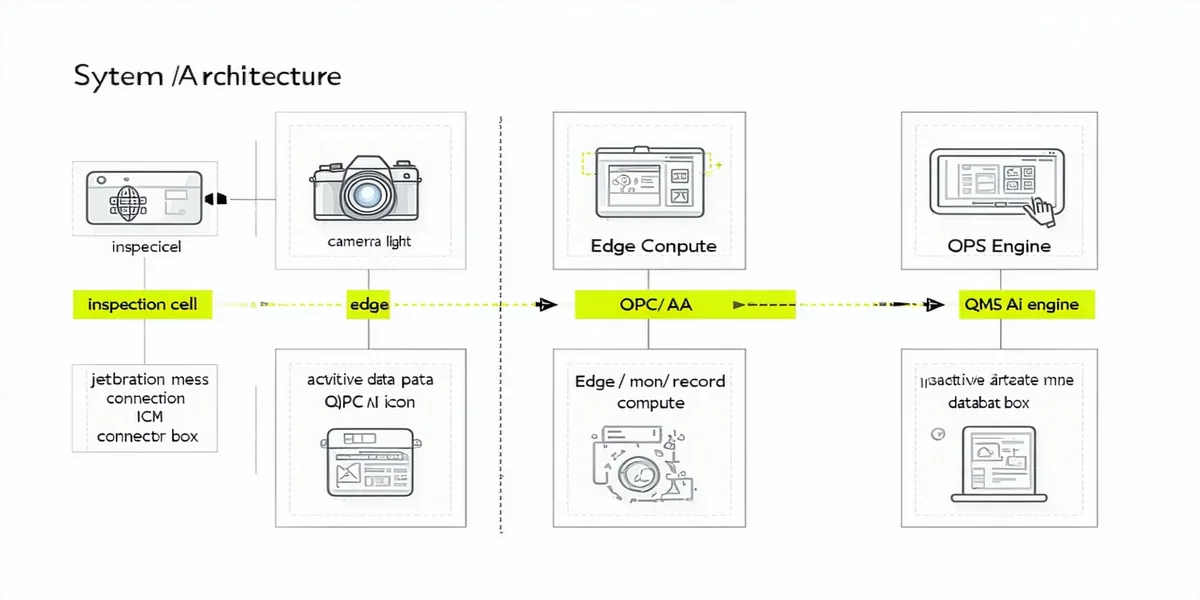
Qcvisionly’s edge compute module processes each part image in under 80 milliseconds from capture to decision—well within the 2-second window between parts at 30 units per minute. The inference loop runs entirely on-site, with no cloud round-trip in the inspection path. Your line keeps moving at rated speed, and every part gets scored, not sampled.

Line-speed inspection system

Customer-Specific Model Fine-Tuning

Generic industrial vision models are not trained on your part geometry, your lighting conditions, or your specific defect types. During a 6-week onboarding engagement, Qcvisionly builds a model on 50,000 or more labeled images from your own rejection bin and production station—reviewed by your quality engineers and calibrated to your OEM tolerance requirements. The model learns your defects, not a textbook version of them.

Custom model fine-tuning process

Siemens Simatic and Rockwell Integration

Pass/fail and defect classification results go directly to your existing Siemens Simatic or Rockwell FactoryTalk PLC via OPC-UA or Ethernet/IP. The divert chute your line already has gets triggered on fail parts—no new control layer, no additional HMI screen required. Integration commissioning at a typical station runs 2–4 days.

PLC integration with Siemens Simatic

From Camera to PLC Decision in 80 Milliseconds

Qcvisionly installs alongside your existing camera hardware, learns your specific defect library during onboarding, and routes inspection decisions directly into your PLC—without adding a new control layer or stopping the line.

01

Camera Onboarding

We connect to your existing Basler, Cognex, Keyence IV-Series, or National Instruments FlexRIO cameras at the inspection station. No new hardware purchase required in most installations. The integration team confirms frame trigger timing with your part-present sensors and validates image resolution against your defect size targets.

02

Defect Library Training

Over 6 weeks, your quality engineers label production images from your own rejection archive. We train a convolutional model on 50,000 or more of those labeled images, covering your specific defect categories—surface scratches, dimensional out-of-tolerance, assembly presence, cosmetic blemishes. The model is calibrated to your OEM specification limits before go-live.

03

PLC Integration

The trained model deploys to an edge compute module at the inspection station. Results—pass, fail, or review—feed to your Siemens Simatic or Rockwell FactoryTalk PLC via OPC-UA within 80 milliseconds of image capture. Divert logic triggers on existing actuation hardware. No middleware server, no additional SCADA screen.

04

Traceability & Continuous Improvement

Every part decision—image, defect class, confidence score, timestamp—writes to the Qcvisionly traceability database. PPAP documentation and SCAR audit packages pull directly from this record. As part geometry or tooling changes accumulate, we recalibrate the model quarterly so escape rate performance holds.

The Numbers Behind the Problem

15–30%

Manual Inspection Escape Rate

On fine surface defects at line speeds above 30 units per minute, manual visual inspection routinely misses 15 to 30 percent of rejects. Fatigue, lighting variation, and shift-to-shift inconsistency compound the problem across multi-day production windows.

$8K–$45K

Cost Per SCAR Event

A single Tier-2 supplier corrective action request from an OEM customer carries $8,000 to $45,000 in combined charges: OEM chargeback, 100% manual sort of affected production windows, root-cause documentation labor, and 8D report preparation. One event often triggers additional containment requirements for subsequent shipments.

4–18 hrs

Yield Hold per Affected Window

When an escape triggers a manual sort campaign, production windows average 4 to 18 hours of yield hold while affected parts are located and sorted. That time comes directly out of scheduled throughput and forces rescheduling conversations with the OEM customer.