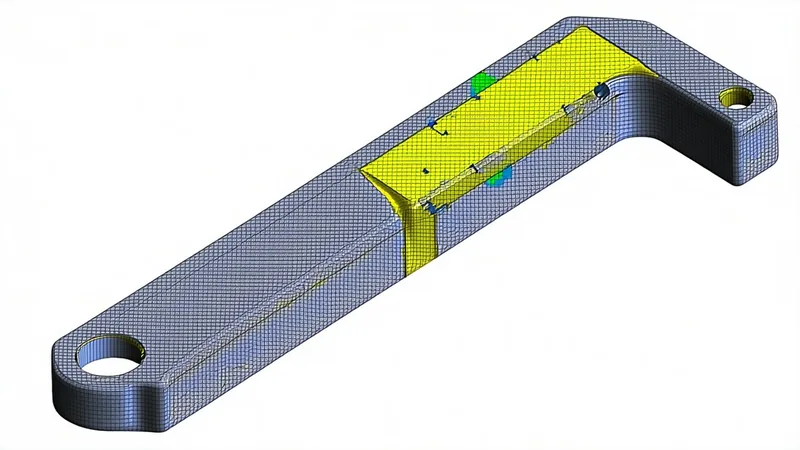
Weld bead inspection is one of the more demanding machine vision applications in automotive production — not because the camera hardware is exotic, but because the geometry being measured is continuous, three-dimensional, and embedded in a metallic surface with high and spatially variable reflectance. This article covers how structured-light 3D vision systems approach the measurement problem: what parameters are measured, how the algorithms extract them from raw sensor data, and what the connection between measurement output and your Weld Procedure Specification (WPS) looks like in practice.
This is written for quality engineers and vision system integrators who have responsibility for weld audit at automotive assembly or fabrication cells — stamped structural assemblies, body-in-white components, suspension links, battery enclosures. If you are evaluating whether structured-light 3D is the right sensing modality for your weld inspection cell, the sensor comparison article in this series covers the modality tradeoffs more broadly. This article assumes you have already decided on structured-light 3D and need to understand the measurement chain.
What the WPS Specifies and What the Vision System Must Measure
A Weld Procedure Specification defines the acceptable range for every geometrically measurable weld parameter. AWS D1.1, ISO 15614, or process-specific OEM welding standards will define limits for bead width, bead height, undercut depth, and the prohibition of specific discontinuity types including weld porosity, weld spatter, and arc strike. The AIAG welding control plan requirements link these WPS parameters back to your APQP control characteristics.
For a typical MIG/MAG weld bead on an automotive structural part, the Control Plan will list measurement requirements in the form of:
- Bead width: nominal ± tolerance, or minimum value, per the joint design drawing
- Bead height (crown height): maximum and minimum per WPS
- Undercut depth: maximum allowable (often 0.5 mm or less for structural welds)
- Arc strike: prohibited outside the weld zone
- Weld spatter: maximum particle count or coverage area in critical zones
- Weld porosity: maximum pore diameter and count for visible surface porosity (subsurface porosity requires X-ray or ultrasonic methods, outside structured-light scope)
These are the measurement targets the structured-light system must output on every inspected weld seam, in production cycle time.
How Structured-Light 3D Acquires a Weld Bead Point Cloud
Structured-light 3D measurement works by projecting a known pattern — typically a sinusoidal fringe pattern at multiple phase steps, or a sequence of binary-coded stripe patterns — onto the target surface and observing the pattern deformation with a calibrated area-scan camera positioned at a known angle relative to the projector. Deformation of the projected pattern encodes the surface height at every pixel, which is triangulated into a 3D point cloud.
For weld bead inspection, the key parameters of the structured-light setup are:
- Measurement range and resolution: A typical automotive weld bead inspection cell requires a Z-range of 15–30 mm to accommodate bead height variation and part fixture tolerance, with a Z-resolution of 10–50 μm to measure undercut depth accurately. Higher resolution requires shorter measurement range — a constraint that must be matched to your WPS tolerances during cell design.
- Lateral resolution: Determined by the camera pixel size and standoff distance. To measure a minimum bead width of 3 mm with adequate feature definition, a lateral resolution of 0.1–0.3 mm per pixel is typical, requiring a 2 MP or higher area-scan camera at 200–400 mm standoff.
- Acquisition speed: Phase-stepped fringe projection requires multiple captures per measurement position — typically 4 to 12 images per phase sequence. A 4-phase binary pattern can complete a full bead scan in under 500 ms at typical automotive robot cell cycle times, but this depends on projector speed and camera frame rate.
- Reflectance handling: Metallic weld beads are specularly reflective with spatially varying local orientation. Standard grayscale-encoded fringe patterns saturate on mirror-like areas of fresh weld metal. This is handled either by polarization filtering, multi-exposure HDR capture, or by using phase-shift patterns with high spatial frequency that remain decodable even with partial saturation.
Point Cloud Processing: From Raw Data to Weld Geometry
The raw 3D point cloud from a structured-light sensor is a dense set of (X, Y, Z) coordinates — typically 0.5 to 2 million points for a 150 × 100 mm field of view. Extracting the weld parameters from that data requires a processing pipeline with several stages:
Reference Plane Fitting
The first step is identifying the base surface on either side of the weld bead — the parent metal plane. A RANSAC plane fit or polynomial surface fit is applied to points outside the bead region, establishing the reference datum from which all weld geometry is measured. This is analogous to the datum reference frame in GD&T: without a stable reference, width and height measurements are not reproducible across parts.
Bead Centerline Detection
The weld bead centerline is extracted by computing the Z-profile along cross-sections perpendicular to the weld direction, finding the local maximum (the crown), and fitting a spline through successive crown points. This centerline is used to parameterize measurements along the bead length, allowing cross-sectional analysis at every point.
Width and Height Extraction
At each cross-sectional plane, bead width is measured as the distance between the two toe points — where the bead profile intersects the reference plane. Bead height (crown height) is the maximum Z deviation above the reference plane. Both are compared to the WPS nominal and tolerance at each measurement point, not just at a single representative cross-section, giving a length-resolved profile of weld geometry against specification.
Undercut Depth Detection
Undercut is one of the most structurally critical weld discontinuities in automotive applications. It appears as a groove or channel at the weld toe, on the parent metal adjacent to the bead, where the base material has been melted away without adequate fill. In the Z-profile, undercut appears as a local depression below the reference plane at the bead toe. The algorithm must distinguish true undercut from measurement noise and from intentional joint geometry (e.g., a T-joint with a visible root). A minimum depth threshold — typically 0.1 mm to avoid noise triggering — is combined with a minimum spatial extent criterion to reduce false-positive calls on weld texture roughness.
Arc Strike and Spatter Detection
Arc strikes — inadvertent electrical discharges on the parent metal surface outside the weld zone — appear as small circular or linear surface anomalies with a characteristic raised rim and center pit. In the 3D point cloud, they are detected by local surface curvature analysis: a small region with high positive curvature (rim) surrounding a small region with negative curvature (pit). Weld spatter particles are detected similarly as isolated local protrusions above the reference surface, filtered by minimum diameter and height above a spatter height threshold.
A Scenario: Exhaust Bracket Weld Audit at a Regional Automotive Fabrication Supplier
Consider a growing stamped and welded components supplier in western Ohio producing exhaust system brackets for an OEM body program in 2024. The weld cell ran three shifts, producing approximately 800 parts per shift. Prior to deploying inline vision inspection, weld quality audit was done by a quality technician on a 1-in-20 sample basis using a weld gauge — a manual device for measuring bead width and undercut depth at a single cross-section per weld.
The sampling approach had a fundamental limitation: a weld that met specification at the gauge measurement point could have a localized undercut at another position along the same bead. After deploying a structured-light 3D inline cell, the supplier generated a continuous Z-profile across the full bead length — averaging 47 measurement cross-sections per 120 mm weld. In commissioning, 3 of the first 200 parts showed a WPS undercut violation at a bead position that would not have been sampled by the manual gauge. All three were traced to an inconsistency in robot speed at the start of the weld sequence, which was subsequently corrected through a weld program parameter adjustment. That class of defect would not have been detectable at 1-in-20 sampling with a single-point manual gauge.
Integration With WPS Documentation and IATF Records
From an IATF 16949 perspective, the vision system's measurement output is a process parameter record under §8.5.1. Each inspection record should contain the part serial number (or shift/time stamp if individual serialization is not in place), the measurement result for each WPS parameter, the pass/fail status per Control Plan specification, and a reference to the WPS document version the inspection criteria were drawn from.
This documentation structure is not an afterthought — it is what makes the inspection cell's results defensible when your OEM customer's Supplier Quality Engineer reviews your Control Plan and asks for evidence that the weld audit method actually detects the critical WPS parameters. The connection between the WPS limits, the AOI measurement criteria, and the per-part inspection records must form an unbroken chain that an internal auditor following IATF §8.5.1 can trace end-to-end.
Limits of Structured-Light 3D for Weld Inspection
We are not saying structured-light 3D is sufficient for all weld quality requirements. It is a surface measurement method. Subsurface porosity — weld gas inclusions deeper than the surface profile — is not detectable by optical methods. AWS D1.1 and similar structural welding standards allow subsurface porosity up to defined limits, and those limits must be verified by radiographic testing (per ASTM E1742 or equivalent) or ultrasonic methods, not by optical inspection. If your OEM customer's Control Plan requires verification of internal weld quality, you need a complementary NDT method alongside the structured-light surface measurement cell.
Structured-light 3D also has limitations on highly contoured joint geometries — T-joints with narrow access, fillet welds in recessed areas, root passes on multi-pass welds — where the camera viewing angle cannot achieve full coverage of the bead toe region. Cell design must account for these constraints in the fixture and camera mounting arrangement before commissioning. Discovering a 15% blind-zone coverage gap during OQ validation, not during APQP process design, is an expensive schedule hit.