Statistical Process Control was designed to work with large measurement datasets — the kind you get when you measure every part rather than every twentieth part. Traditional in-process gauging on automotive production lines rarely generates that dataset, because a CMM takes three minutes per part, a surface finish stylus gauge takes ten seconds, and most functional gauges require a human operator to position and read the instrument. The result is sampling-based SPC: Cpk and Ppk calculations built on 30 to 100 measurements across a production run of thousands of parts, with control charts updated once per hour or less.
Vision inspection changes this. When an inline AOI cell measures dimensional or surface characteristics on every part in under two seconds, it produces a measurement record for every part. That changes not just the volume of SPC data but the nature of the control chart — from a tool that detects process drift after it has produced substantial off-spec parts, to a tool that detects process drift as it is beginning. This article covers how to structure vision inspection measurement output as SPC-ready data and what Cpk and Ppk calculations from 100% coverage actually mean for process monitoring.
What AIAG SPC Guidelines Require from the Measurement Data
The AIAG Statistical Process Control reference manual (currently in its 2nd edition) defines the data requirements for computing Cp, Cpk, Pp, and Ppk. The key distinction between Cpk (process capability index) and Ppk (process performance index) is important in the context of vision inspection:
- Cpk uses the within-subgroup estimate of process standard deviation (σ̂ within), calculated from the average moving range or range statistic of consecutive measurements. It describes the inherent capability of a stable process, excluding between-subgroup variation.
- Ppk uses the overall sample standard deviation of all measurements. It describes actual performance including all sources of variation — within-shift, between-shift, tooling wear, ambient changes.
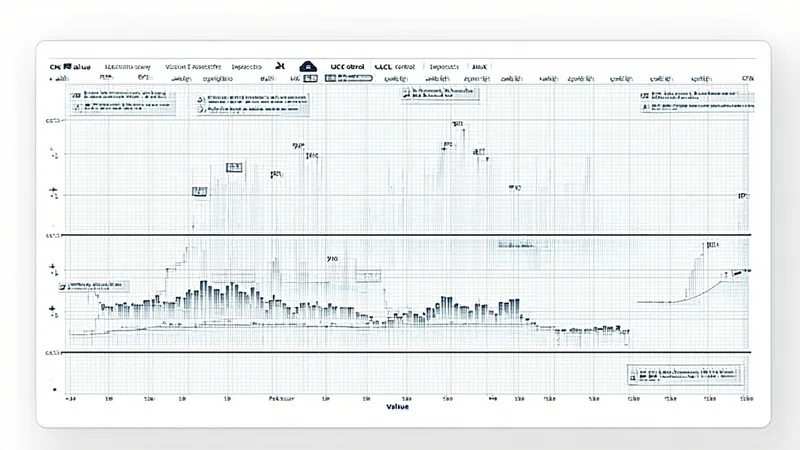
For vision inspection with 100% part coverage, every part is its own subgroup of size 1 (in an individuals-MR chart configuration). The moving range between consecutive part measurements estimates within-subgroup variation. This is the correct control chart configuration for 100% continuous inspection: the individuals (I) chart for the measurement value, and the moving range (MR) chart for the range between consecutive measurements. Upper Control Limit (UCL) and Lower Control Limit (LCL) on both charts are set at ±3σ from the center line, where σ is estimated from the average moving range.
In this configuration, Cpk = min[(USL − x̄) / (3σ̂), (x̄ − LSL) / (3σ̂)] where σ̂ is the within-subgroup standard deviation estimate from the moving range. Ppk = min[(USL − x̄) / (3s), (x̄ − LSL) / (3s)] where s is the overall sample standard deviation of all measurements.
Structuring Vision Inspection Output as SPC-Ready Data
Vision inspection measurement output is typically generated as a structured inspection record per part — containing the part identifier (serial number, timestamp, or shift/sequence number), measurement results per characteristic, and pass/fail status. To feed SPC calculations, this per-part record needs two additional elements beyond what a basic pass/fail logging system provides:
- Continuous measurement value, not just pass/fail status: An inspection record that stores only "PASS" or "FAIL" cannot be used for variable SPC. The actual measured value for each continuous characteristic (bead width in mm, Ra in μm, feature position in mm from datum) must be stored as a numeric field. This is a system configuration choice that must be made at deployment — retrofitting continuous-value logging to a system configured for binary logging may require software changes.
- Subgroup ordering: For SPC charts, the sequence in which measurements were made matters. The time-ordered sequence of measurements is what gives the I-MR chart its sensitivity to temporal process drift. Vision inspection records must include a timestamp or production sequence number that preserves measurement order. If parts are reinspected or measurements are made out of production sequence, those must be flagged and excluded from or noted in the SPC calculation to avoid disrupting the time-order assumption.
The AIAG SPC manual recommends minimum subgroup sizes and run lengths for establishing control chart limits. For 100% inspection, a minimum of 25 to 30 consecutive parts is typically used to establish initial UCL/LCL before the chart goes live for ongoing monitoring. Once established, the control limits are held fixed until a deliberate process improvement or tooling change justifies recalculating them.
Cpk Output Per Defect Class: What It Tells You
In AOI defect detection, many detected characteristics are attribute data — a void is present or not present — rather than continuous measurement data. Attribute data requires attribute control charts (p-chart for proportion defective, u-chart for defects per unit), not Cpk. The confusion sometimes arises because quality engineers apply the term "Cpk" loosely to all inspection output.
Proper Cpk/Ppk calculation applies only to the continuously measured dimensional characteristics — weld bead width, feature position, Ra value, gap dimension. For attribute defect classes (void presence, crack detection, contamination), the correct SPC tool is the p-chart or c-chart, and the control limits are based on the average defect rate and its standard deviation from a baseline production run.
For an inline weld inspection cell measuring bead width continuously, a well-configured system will output both: Cpk for the continuous bead width measurement (is the process consistently producing beads within WPS tolerance?), and a defect rate chart for attribute classifications like arc strike presence or spatter count (are these event-type defects occurring at a statistically unusual rate?). Running both chart types in parallel gives a complete picture of process performance — the continuous capability index for the geometric parameter, and the event control chart for the binary defect classes.
A Scenario: Process Capability Recovery at a Michigan Stamping Supplier
Consider a plausible situation at a growing metal stamping supplier in West Michigan in 2024 running a punch-and-form press cell for automotive bracket assemblies. Their control plan required Cpk ≥ 1.33 for hole position on a safety-relevant mounting bracket — a ±0.25 mm position tolerance. Before inline vision inspection, Cpk was measured quarterly from a 30-piece CMM sample batch — a single snapshot per quarter.
After deploying an area-scan inline dimensional cell with 100% part coverage, the first week of continuous data told a different story: Cpk averaged 1.41 across the shift but showed a systematic drift pattern — Cpk declining from approximately 1.45 at shift start to approximately 1.18 by shift end before recovering after the next tooling reset. The quarterly sample had consistently captured parts from the middle of the shift (the typical time for quality checks), masking the end-of-shift degradation. The inline SPC data revealed a progressive thermal expansion effect in the die set as the press warmed up and then cooled during a mid-shift lunch break.
That finding required a control plan update: the die set temperature stabilization procedure was formalized as a process parameter, with an SPC monitoring point for the first 15 parts after any production stop exceeding 30 minutes. The Cpk improvement was not from changing the tooling — it was from managing the thermal stabilization cycle consistently, enabled by continuous SPC data that revealed the pattern.
Connecting Vision SPC Output to Your QMS and MES
SPC data generated by a vision inspection cell needs to flow into the quality management system to be useful — not stay locked in the inspection cell's local data store. The standard integration path is via OPC UA data push from the edge compute unit to the plant MES or QMS historian. The AIAG SPC guidelines do not specify a data format, but common QMS platforms that consume SPC data from production equipment support OPC UA and/or CSV import with defined column structures.
For IATF 16949 §8.5.1 compliance, the SPC records generated from vision inspection should be stored in the QMS in a way that links them to the Control Plan revision in effect at the time of measurement, to the specific production line and shift, and to the product part number and revision level. This traceability chain is what allows a quality team to retrieve SPC data for a specific part number and date range in response to an OEM customer quality concern or warranty claim investigation.
What 100% SPC Coverage Does Not Replace
We are not saying that 100% SPC coverage from vision inspection eliminates the need for periodic capability studies or MSA re-evaluation. The SPC control chart detects process shifts and trends — it is a process monitoring tool, not a measurement system validation tool. Measurement system drift, lens contamination, illumination decay, or calibration shift in the vision cell will not show up as a control chart signal if the drift is gradual and affects all measurements equally. It will show up as a systematic bias in the measurement values relative to a reference standard.
Periodic MSA re-evaluation studies — comparing the vision system output to a reference CMM or gauge on a set of reference parts — should be scheduled at regular intervals, with intervals informed by the stability history of the specific sensor type and installation environment. For a production floor with vibration, thermal variation, and periodic cleaning cycles, a quarterly MSA touchpoint is a reasonable starting interval; adjust based on empirical stability evidence from the first year of operation.
Process capability data at this density gives quality engineers a genuinely different level of process visibility — the kind that makes root cause analysis tractable rather than speculative. Building the data structure to capture it correctly from the start is worth the configuration effort.