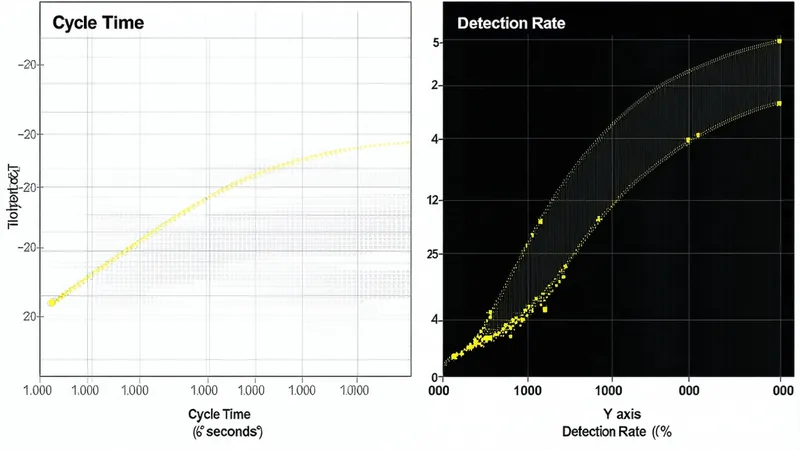
At the commissioning review for a stamped body panel inspection cell at a mid-size Michigan Tier-1 plant, the debate always comes down to the same question: can we hit the line takt and still catch the defects that matter? The production engineer wants inspection completed in under 1.8s per part. The quality engineer wants a detection threshold tuned tight enough to flag a 0.4mm surface void that is a customer-defined reject. Those two requirements may or may not coexist, depending on sensor selection, processing architecture, and how the APQP escape criteria were defined upstream.
This guide works through the engineering constraints that govern the cycle time versus detection rate trade-off, and explains how to set thresholds grounded in your control plan rather than arbitrary sensitivity tuning.
The Time Budget Decomposition
Inspection cycle time is not a single number — it is the sum of five distinct phases, each with a different optimization lever:
- Trigger latency: time from part-in-position signal to camera exposure start. For GigE Vision cameras on a properly configured dedicated VLAN, this is typically
2–8ms. Camera Link with hardware trigger is sub-millisecond but requires dedicated frame grabber hardware. - Exposure duration: determined by sensor sensitivity, illumination intensity, and acceptable motion blur. At
300mm/spart travel speed on a conveyor, a1msexposure produces roughly0.3mmof motion smear — acceptable for most 2D defect detection but inadequate for sub-millimeter dimensional measurement. - Image transfer time: at GigE Vision
1Gbpsbandwidth, a5MPmonochrome image transfers in approximately40ms. USB3 Vision at5Gbpsbrings this to under10msfor the same frame. Camera Link at full configuration supports up to6.8Gbps— the right choice when transfer time is a hard constraint. - Algorithm processing time: for blob analysis and template matching on a
5MPframe using MATROX MIL or Halcon running on modern industrial PC hardware, typical processing times are30–150msdepending on algorithm complexity and region-of-interest count. Deep-learning-based classification pipelines running on GPU-accelerated edge compute can process comparable frames in20–80ms. - Decision and output latency: PLC handshake over OPC UA or discrete I/O for pass/fail output adds
5–20msdepending on communication protocol and PLC scan cycle. Siemens TIA Portal and Rockwell Studio 5000 both support sub-10msdiscrete I/O response when properly configured.
Sum those phases for a typical GigE Vision setup and you get a realistic 100–250ms inspection window — well within a 2-second takt for most configurations. The constraint is rarely bandwidth or processing speed; it is usually the exposure-resolution-motion triangle that introduces the real engineering tension.
Resolution, Field of View, and the Defect Size Floor
Detection sensitivity is bounded by pixel resolution at the inspection surface. The relationship is straightforward: a 5MP sensor (2448 × 2048px) imaging a 300mm × 250mm part surface provides a ground sampling distance of approximately 0.12mm/px. Reliably detecting a feature requires it to span at least 3–5 pixels in the smallest dimension — putting the practical detection floor for this configuration at roughly 0.4–0.6mm.
If your control plan specifies a minimum detectable void size of 0.3mm, this configuration fails at this field of view. The options are: (a) increase sensor resolution to 12MP or higher, (b) reduce the field of view and inspect in multiple stations, or (c) accept a 0.4mm floor and document that 0.3–0.4mm features are outside system capability in the MSA/Gauge R&R study.
This is a critical design decision that must be made during APQP Phase 3 (process design and development) — not discovered during PPAP. The control plan should explicitly state which defect classes and minimum sizes the automated system is the control method for, and which remain operator-flagged through supplemental sampling.
Detection Threshold Setting: APQP Escape Criteria as the Anchor
Detection thresholds in AOI systems govern the trade-off between detection rate and false-reject rate (also called false-positive rate or nuisance reject rate). A threshold set too aggressively flags marginal surface texture variation as rejects; one set too conservatively misses real defects that constitute quality escapes per your APQP control plan.
The correct engineering anchor for threshold setting is the escape criteria in your APQP control plan and FMEA — specifically, the detection ranking assigned to each defect class. A defect class with FMEA Detection = 1 (near-certain detection) requires a more sensitive threshold than one with Detection = 4 (likely detected). This means your threshold tuning exercise is not an abstract optimization — it is tied to the risk priority numbers that your IATF 16949 quality system depends on.
In practice, a DOE (design of experiment) approach to threshold validation works as follows:
- Prepare a golden sample set:
50–100confirmed-good parts and50–100seeded-defect parts with documented defect sizes and classes from your control plan - Run the sample set through the inspection system at multiple threshold settings, recording detection rate and false-reject rate at each level
- Plot the ROC curve (receiver operating characteristic) for each defect class
- Select operating thresholds that achieve the Detection ranking target from FMEA while holding false-reject rate within the production economics tolerance (typically under
0.5–2%for automotive Tier-1) - Document the threshold-ROC study as part of the IQ/OQ/PQ validation package
False-Reject Rate: The Production Line Economics
We are not saying that detection rate is the only metric that matters. A detection rate of 99.8% at a false-reject rate of 8% is operationally unacceptable in most Tier-1 environments — the resulting re-inspection queue absorbs operator time and creates rework bottlenecks that defeat the purpose of automated inspection.
False-reject rate carries a direct production cost. Consider a stamping cell producing 400 parts per shift: a 3% false-reject rate generates 12 parts per shift that require manual re-inspection. At 5 minutes per re-inspection, that is 60 minutes of operator labor per shift — one full operator-hour consumed by system noise rather than genuine defect triage.
The acceptable false-reject rate depends on part value, downstream rework cost, and available inspection manpower. For high-cycle, low-value stampings (e.g., body brackets), a 1–2% false-reject rate is typically the practical ceiling. For precision machined castings with complex re-inspection procedures, even 0.5% may be the operational limit.
This means the threshold tuning exercise is actually a two-constraint optimization: meet the FMEA Detection target while holding false-reject rate within production economics limits. When those two constraints cannot simultaneously be met with available sensor resolution and illumination, the correct response is to escalate to hardware redesign — not to compromise either constraint.
Cycle Time Under Multi-Camera Orchestration
When a single camera cannot simultaneously cover the required field of view at the required resolution, multi-camera configurations divide the inspection zone across multiple sensors imaging in parallel. A three-camera cell can triple the effective inspection area while maintaining individual camera cycle times — but introduces synchronization requirements.
Under GenICam-compliant hardware synchronization (using the Action Command or scheduled action features in GigE Vision), all cameras in a cell can be triggered to expose within a single microsecond of each other. This eliminates parallax artifacts from part motion between exposures — critical when part features span camera boundaries.
Processing time for a multi-camera cell is determined by the slowest camera-algorithm pair. A three-camera cell where cameras A and B complete in 80ms each but camera C requires 150ms for a more complex algorithm has an effective processing time of 150ms, not 310ms — because the cameras run in parallel on dedicated processing threads. This is why edge compute architecture choices matter: an inspection server with 16 CPU cores and dedicated GPU can parallelize camera processing in ways that a shared plant-floor PC cannot.
Where Structured Light Changes the Equation
Structured-light 3D sensors add a fundamentally different constraint: they require the part to be stationary (or near-stationary) during pattern projection. A typical multi-shot structured light measurement cycle projects 4–8 fringe patterns and captures the corresponding images — requiring 200–800ms of stable illumination per measurement position, depending on sensor and algorithm. This is incompatible with continuous-motion conveyors.
For applications where structured light is required (weld bead geometry, formed part dimensional inspection), the standard solution is an indexing station that stops parts in position for structured light measurement, then releases them to the downstream conveyor. The cycle time impact of this stop-and-measure step must be engineered into the line layout during APQP Phase 2, not retrofitted to an existing continuous-motion line.
The alternative is single-shot structured light or time-of-flight depth sensors that operate at speeds compatible with slow-motion conveyors (under 50mm/s) — though these trade point cloud density and depth resolution for speed.
Setting Thresholds Before Live Production
A common commissioning mistake is to tune detection thresholds using live production parts during line validation rather than the controlled golden sample set approach described above. Live production tuning creates three problems: defect ground truth is uncertain (you are tuning against parts you haven't fully inspected), statistical sample sizes are too small, and the pressure to hit production targets biases threshold selection toward under-sensitivity.
Thresholds should be locked before the OQ (operational qualification) phase begins, validated against the golden sample set, and only adjusted through a formal change management process documented in the inspection system's configuration control record. This is the approach that survives an IATF 16949 internal audit — where the auditor will ask for evidence that the detection threshold was set against a documented requirement, not adjusted iteratively until false-reject rate was acceptable to production.
The cycle time versus detection rate trade-off is ultimately an engineering design question that must be answered at system specification time, using your APQP control plan defect classes, the FMEA Detection rankings for each defect type, and the production economics of your specific line. Hardware selection, sensor resolution, and illumination design follow from those inputs — not the other way around.
If you are sizing a new AOI cell or requalifying an existing one, contact us to discuss how Qcvisionly structures the golden sample validation and threshold DOE as part of the standard pilot scope.